«Soy consciente de que soy único»: el podcast de phaware® «
», episodio 558: Anton Morkin
Cuando al hijo de Anton Morkin le diagnosticaron hipertensión pulmonar «idiopática», él se negó a aceptar como respuesta que «no se conociera la causa». Lo que siguió fue un curso intensivo de genética, el descubrimiento de una mutación rara y la creación de una coalición mundial, TBX4Life.
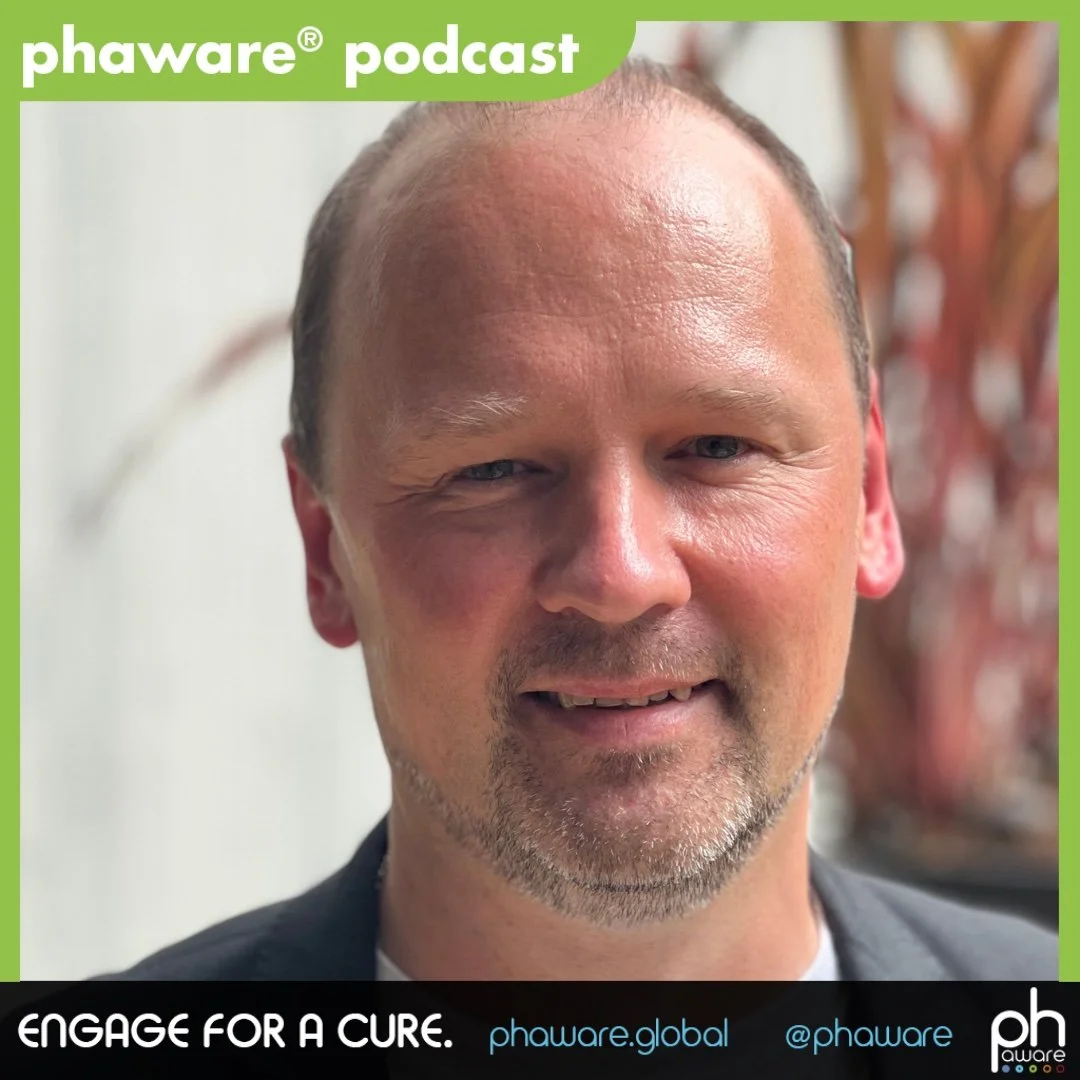
My name is Anton Morkin. I am from Germany. In 2020, my son was diagnosed with severe pulmonary hypertension. We were just rushed into many new things for us. People were saying your child will die probably in the next week or month. They did not know how long he’d survive. They told us this is pulmonary hypertension. That was the first time when I heard about it. I have a degree in physics and I work at Apple as a IT professional. My education in biology and medicine is zero. I didn’t know anything about these type of diseases. I didn’t know really that there are so many diseases which do not have any cure. My biggest worry was about cancer. We were just rushed into this within a few days. We were told that my son Daniel, he’ll not recover, most likely, from this severe pulmonary hypertension and he’s not reactive to what they called NO (nitric oxide) test. They started to talk with us about lung transplantation. All of that happened just in few days.
My story here may be very similar to stories of many, many families. Still, Daniel surprised everyone. Apparently, he became actually very responsive on the therapy. Within just a few weeks, he started to recover very well, which surprised us and also his doctors, because they didn’t expect that. That gave us some time to reflect. I was doing the following things… Every day I was caring for my son. He was 16 months at that point, so I was caring for him on the day, because my wife was caring for him in the night because he was in the ICU. During nights I was studying pulmonary hypertension to understand what is this and what I can do. So, I started to reach out to other people and exploring what is possible, how to treat it better. That was my first thing.
Still, I was not satisfied with the fact that I do not understand why that happened, because the first diagnosis was idiopathic pulmonary hypertension. There is not any explanation actually why that happened. For me, that was always disappointing, because it means that if you don’t know why that happened, you don’t know how to treat it. Then, where Daniel was diagnosed, they ordered a genetic test, which was really nice, because I know it doesn’t happen in every place. Apparently, there are places where we still do not refer to genetic tests, which is, in my opinion, really weird. Because certainly genetics play in children more than 50% by genetics from this pulmonary arterial hypertension. They performed a genetic test. It took a while actually for them to get a result. It took months. But they did that and they did find a mutation and a gene, which is named TBX4. That was the first time when I heard about TBX4.
That forced me, actually, to go into that area. First of all, that gave me at least some sense. Okay, so something got broken in his DNA and that is the reason. At least I know where to look to. I started to research in genetics. I had to educate myself on genetics actually. I educated myself on pulmonary hypertension in pulmonology, then in genetics. After that education on genetics, I started to understand how the things are connected together. TBX4 syndrome, it affects lower limbs, it then affects lungs during embryo development the most. Depending on the mutation and that a combination of unknown factors, it can create a different impact on the body.
On a skeletal side, it primarily affects a knees, that is so-called small patella syndrome. It is also rare disease. I was living with a small patella syndrome for 45 years without knowing that. When I had some troubles with the knees, I came to an orthopedist and one of them said, “Your knees are so strange, I never seen them. Never seen such.” Okay, okay. So how does help? Finally, with this TBX4 syndrome, I was able to explain this. Small patella syndrome literally means that your patella is small and sometimes it’s positioned higher than it should be. If you don’t train your knees in the right way, then you just have increased pain. This is what happened with me. So it happened from 25 till 35. And then at 35, I was barely able to walk on the stairs. That is just because of this gene mutation.
Or hip replacement, that’s another one. In adults for example, hip problems can also be severe. If in the family there are such histories and there is one with pulmonary hypertension, then I would rather go and do a test, because it’s very likely that it is TBX4. In some humans, it can create more damage. In some humans it creates less damage. The good example of that is me. I carry the same gene and my son actually inherited this gene from me, this broken gene from me. I’m almost 50 years old and I’m still alive. They named me an asymptomatic carrier. I hope that I will continue to be an asymptomatic carrier. Who knows? But I didn’t get pulmonary hypertension. But at the point, it was important for me was to understand that, okay, so this is not idiopathic, this is good. I do know what is my enemy and what I can fight with.
I started to separate this story from the story of general pulmonary hypertension. Because when you look at pediatric pulmonary hypertension, diversity is so high and you do not understand what to expect, because there are children dying. As long as there are no differentiating factors, you do not understand what to expect. So, in the first year when we were diagnosed and we gotten to those Facebook groups, a lot of children are diagnosed with a very severe situation, but then it can go to a more stabilized scenario. That is actually what happened with my son. He’s now six years old. He’s stable for the last five years. He’s on triple therapy. He’s living a full life. He’s doing everything, everything. He does Taekwondo. He does swimming. He’s capable of doing the things. Having him in that condition allows me also to do more things.
I do understand those parents also who for example, have babies in ICU, right? As long as you stay there, you do not have that much chance to do some other things. I started to connect families. I was able to identify them actually, because since this is a skeletal disease plus lung disease. Skeletal signs, you can see them. Interestingly, some of the families, they actually found that they maybe have the TBX4 for mutation by skeletal signs. That is why from the age of 25 years old, I was not able to run and jump. The gene affected my knees. They connected those things and then we made an official test and that confirmed also that I have that mutation. Since I was able to connect several families, I thought, “Okay, so maybe we can somehow do this together.” We can help each other. Help to bring this disease to be more heard, to make some noise around this disease. Fortunately, this knowledge was already there.
The correlation between TBX4 and pulmonary hypertension was made only in 2013. Before that, nobody knew about that. The correlation between TBX4 and developmental lung disease was even later in 2019, and my son was diagnosed in 2020. I started to read those papers about this TBX4 and how that works and how that creates pulmonary hypertension. I found that in those publications, they say more research is needed, more research is needed. That data isn’t complete. They just described few cases. Few cases in France, few cases in the US. In my career, I’ve been a program manager for 20 years. Essentially, what I’ve been doing for 20 years is connecting people from remote places, connecting them to deliver something. I’m thought maybe I can do something here.
I approached just a single person. I was so lucky that I approached the right person. I approached Dr. Eric Austin from Vanderbilt University. He was so great in the conversation. I just approached him, just made a Zoom call. We had a conversation and Eric said, “Maybe I can help somehow or you can help somehow.” Eric didn’t know what to do and I didn’t know what to do, but we had a great call. So he said that, “Yes, I will support you as long as you know what to do.” I was lucky to attend soon a seminar for people who would like to start a rare disease research organization. This helped me a lot to understand next steps. Then, I approached Eric and said, “Okay, I know what to do. Let’s start a foundation. Let’s start this international collaboration.” That is how we actually create the TBX4Life.
It took us about maybe one year to ramp it up to understand how to engage professionals, how to position this foundation. When I was starting this, there were already enough different foundations, especially for pulmonary hypertension like phaware, for example. There’s phaware, and PHA US, PHA Europe. I was thinking, okay, so I do not want to create another pulmonary hypertension organization. It does not make any sense.
What I wanted was to bring the focus on my case and that focus on TBX4. I wanted to be sure that my specific cause is on top. I’m a person who can reach out to anybody to make this happen. We cover holistically the genetic condition and focus on that. On the community side, I started to connect more and more and more and more people. Currently, we are still relatively small, but again, we are talking about ultra-rare disease. I think that it’s good that we already have more than a hundred members in this community from New Zealand to Europe, Australia, almost every state in the US, in Spain, Germany, Netherlands. About 15 countries, currently, whom we connected. We connect them together. We educate them as much as possible, give them information about this disease, connect them to specialists where that is possible. But we also give them a platform also to exchange that information between themselves. Because yeah, they can join for example, and they should join those communities for pulmonary hypertension, but those communities will not tell them about the experience that we have for this specific disease. We give that portion which is more for them.
A couple years ago, we achieved a state where we were comfortable to set a goal for the organization to cure TBX4. We all want to do many beautiful things, but essentially I think that for our children we need a cure. For me, that was extremely important. In the beginning, we were very cautious of not setting some artificial goals. Because I’m not a scientist — I can say anything. I can say any nonsense. I can say, “Okay, let’s cure it tomorrow.” But clinicians and scientists — they cannot do that, because they do understand how much is behind that. I understand that well. It’s not an easy journey. It’s a very, very tough journey. It can be multi-year or can be even multi-decades, but important as long as there is such a goal and people are committed to that, then that drives us.
What was so essential for me in “what would be the roadmap to cure?” Essentially, this is like a drug development lifecycle. We need some understanding on the genes. We need understanding on how genes work, proteins work, how the cells and lung development happens, and we need to find medical compounds and try them. For example, first in the very basic models. You know what is possible currently? You can take blood from a patient and from the blood you can create cells and those cells are reprogrammed. There are ways to reprogram them into the embryonic state. You can just take blood, reprogram it to that embryonic state (so-called induced pluripotent stem cells (iPSCs). Then, from that state, program them to your lungs. You can create just a cell which is for lungs. They are capable, even now, to create so-called organoids, which contain different cells. Because for example, in the lungs there are about 10 different types of cells, and they co-culture them together and create organoids like a small part of the lung.
There are efforts, by the way, now, in science to grow the whole lung, because there is a big, big problem, for example, for lung transplantation that you transplant the lungs, but those have a lot of troubles, because the body thinks that there’s something wrong. There’s acute rejection, chronic rejection. All of this stuff happens. So, if someone would be able to grow lungs from the stem cells of the patient, then there’ll be none of those problems. The science is moving, so that’s why I’m so fascinated now with all this happening and why actually this ‘cure TBX4’, for me, is like, yes, maybe this is very ambitious, but still it’s not necessarily unrealistic, because science currently is going amazingly fast. Just amazingly fast. It is just exponential. What was taking 10 years five years ago, now can be done just two years.
One of the things, for example, which we’re now doing in this initiative, we are collect blood from patients and we would like to enroll more and more patients so that we can create those stem cells and make those models so that we can test different medical compounds and see if they can actually recover this impact. If that will be found in stem cells, we can do that on animal models like in mice, for example. When we can prove that in mice, then we can go and try that on humans. It’s very simplified picture, honestly speaking, but I know the path. We have in our initiative, all the people who do understand this in all the details. We have researchers for cells, people who research for animal models, people who are geneticists, people who research how genes are connected. We have people who use artificial intelligence to study correlations between genes. We have clinicians, and more.
I visited almost every pediatric pulmonary hypertension center. I was in Colorado, in Boston, in many other places. I met with almost each of those who lead pulmonary hypertension programs in different sites. In Texas, in Vanderbilt, at UCSF, and Stanford, and also in Europe and Netherlands. We connected all these clinicians together. I think that we have great number of very motivated and skilled people. We just need a little bit of push and continue that.
Tengo una foto de mi hijo justo delante de mí, en el móvil. Una foto de cuando le diagnosticaron por primera vez. Es muy emotivo. Pasaron cinco años y sigue conmoviendo. Creo que esta iniciativa es también mi respuesta. No estoy segura de si realmente haré algo por él. No lo sé. Pero sé que, si no lo hiciera, no habría excusa.
He recorrido ese camino de cinco años. Lo mantengo separado. Separo su historia y esta historia de TBX4Life; la historia de mi hijo y la historia de TBX4Life. Lo hago a propósito, porque no puedo dedicarle el 100 % de mi tiempo y limitarme a decirle: «Lo siento, hijo. No puedo hacer nada contigo porque estaré ocupada con TBX4Life». Creo que eso es injusto para él. Así que mi mayor reto es, en realidad, mantener ese equilibrio, tener tiempo suficiente para estar con él y con el resto de mi familia. Tengo otra hija que, afortunadamente, no está afectada. No es portadora. Tengo un trabajo principal al que acudir. Todo lo que hago en TBX4Life es, sencillamente, voluntariado. No recibo ni un céntimo por TBX4Life, al igual que los demás que se unen a mí para ofrecer su tiempo como voluntarios. No nos pagan. Tenemos nuestros otros trabajos. Yo tengo mi trabajo, que me proporciona esos ingresos, lo que me permite llevar la vida que puedo, y necesito encontrar el equilibrio. Mi trabajo, mi familia y TBX4Life en el equilibrio adecuado.
No es tan fácil, pero es posible. Hago lo que puedo para aumentar sus posibilidades. De eso se trata, ¿no? Por supuesto, me encantaría salvar a tantos niños como fuera posible, pero no puedo dedicarle toda mi vida, y mi hijo no puede vivir sin mí, ¿verdad? Lo que quiero decir y compartir, quizá también en este podcast, es que quienes empiezan algo, hacen algo, crean iniciativas o las apoyan, quienes dedican su tiempo a reflexionar sobre ello, etc., se lo merecen. Eso tiene que suceder. Esta era de las enfermedades raras y de los grupos de defensa de las mismas empezó a transformarse hace unos 15 años. Cada vez se respeta más. Eso también forma parte de mi motivación, porque no sé si sería menos positivo para mí si me pasara todos los días viendo cómo está mi hijo… Afortunadamente, está estable, como he dicho. Pero no sé cuánto tiempo seguirá así. No lo sé. Simplemente no puedo quedarme sentada sin hacer nada, no puedo hacerlo.
No soy religioso, así que no puedo rezar. Bueno, puedo, pero es poco probable que sirva de algo. Así que no puedo delegar esto en nadie. Por eso, lo haré yo mismo. Necesito hacerlo yo mismo. Si sirve de algo, servirá. Si no, al menos lo habré intentado.
Me llamo Anton Morkin y soy consciente de que mi hijo es un caso poco común.
###
AYÚDANOS A HACER HISTORIA EN PH
Más información phaware.global
Escucha y suscríbete phaware.global/podcast
Apoya el movimiento phaware.global/donate
Comparte tu historia info@phaware.global
Descarga nuestra aplicación phaware.global/heartworksapp
Sigue a @phaware · #phaware