The Insurance Plan You Never Knew You Needed
I’m Aware That I’m Rare: the phaware® podcast
Episode 567 - Nicholas Kolaitis, MD
What does a lung transplant have in common with car insurance? More than you’d think. Dr. Nicholas Kolaitis shares why seeing a transplant team early, even if you’re stable, can help protect your future.
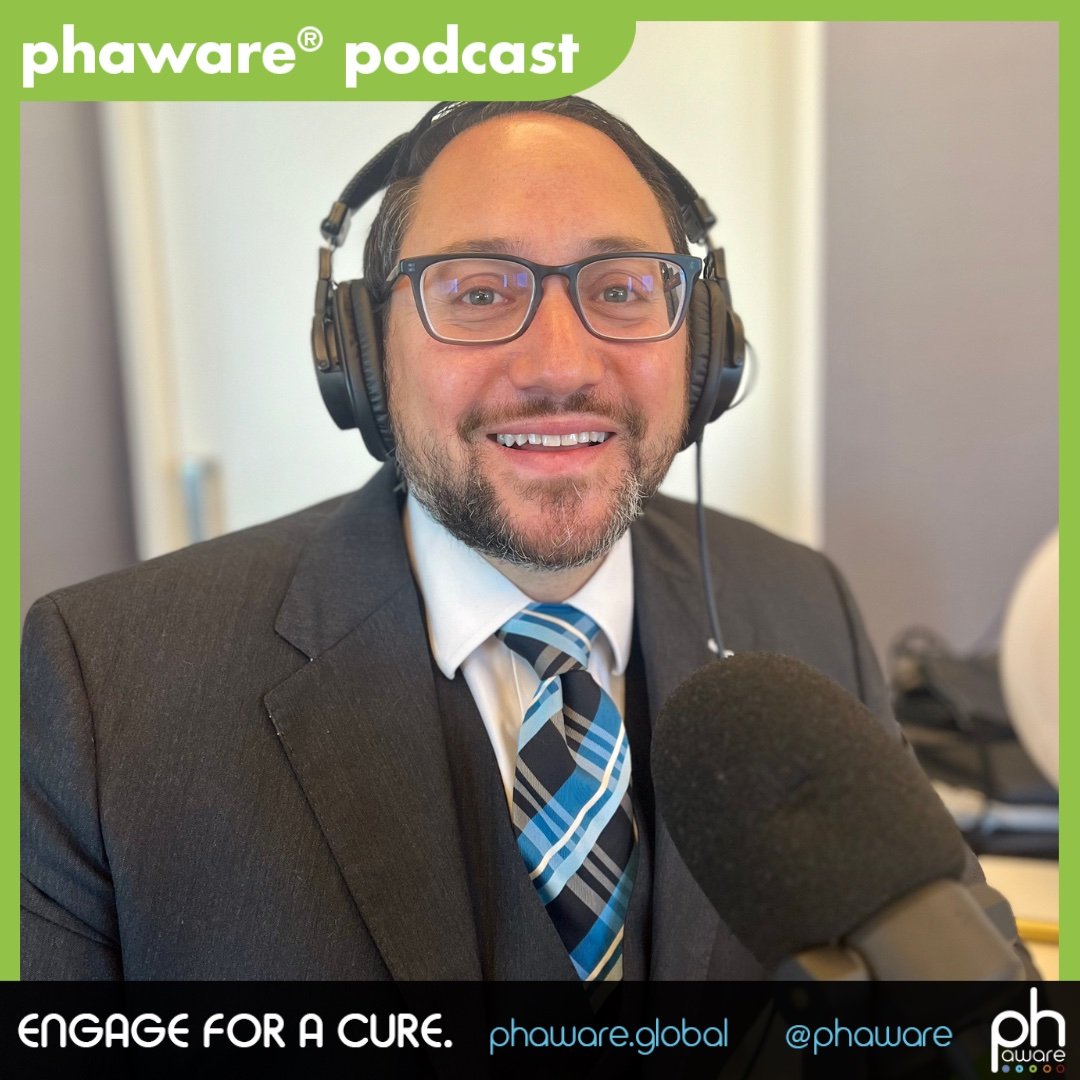
I’m Nicholas Kolaitis from the University of California, San Francisco. I’m a pulmonologist who does lung transplantation and pulmonary hypertension. The thing that I want to talk about today is lung transplant, and some of the issues surrounding lung transplant, as well as, why it’s important to engage with the transplant team as a patient with pulmonary hypertension.
First thing, is a couple of disclosures. One is that, as I said, I’m a transplant doctor and a pulmonary hypertension doctor, and I’ve lost people, patients of mine, who were referred to transplant late. Patients who maybe could have had an opportunity for transplant had they been referred earlier. That is not something that I want for anybody. I want transplant to be an option if people need it.
The second disclosure is that getting referred for transplant, talking to the transplant doctors, being evaluated for transplant, thinking about transplant, does not mean that you’re getting transplanted. So that, I think, is a big misconception is that when somebody brings up transplant, it’s not that you need the transplant right away, at least it shouldn’t be. If the pulmonologist or the cardiologist who’s taking care of you says that you need a transplant now, it’s probably too late for you to actually go forward and be evaluated. You probably can still do it, but it makes the road much more challenging.
When we think about transplant, the question is what is transplant and why do we do transplant?
There’s sort of two aims of transplant. One is to improve somebody’s quality of life, and the other is to improve their survival. Transplant is quite effective for both of these things. So, if you look at people who’ve undergone transplant at my center, for example, at UCSF, our median survival post-transplant is about 11 and a half years post-transplant, which means that these are people who you would think would not have been living anymore without the transplant. We typically only think about putting people on a transplant list if we worry that they’re going to die within the next two years without transplant. So, 50% of them are alive 11 and a half years after the transplant. That’s pretty good at extending your survival. Our longest survivor is over 30 years out of her transplant. That’s not an uncommon thing that we see people throughout the world that are decades out of their lung transplant.
The other is that it improves your quality of life. So, you don’t need to be on parental therapy anymore, if you are. You do need to be on a bunch of different medicines. But people who’ve undergone transplant, we’ve looked at this at our center, they’ve got dramatic improvements in quality of life, they improve their physical quality of life, they improve their mental quality of life, they improve their respiratory quality of life, depression scores get better, frailty gets better, cognition gets better. All these things get better after transplant. So, transplant can be really effective for the right person.
So, sounds pretty great, right? Well, why do we wait?
We wait as a transplant team to do it until we actually need to because we want you to live as long as possible, right? No transplant center wants to transplant somebody too early. Getting referred to your transplant center and talking to your transplant team about transplant early, that’s great. That’s not a bad thing. Transplant is scary though. It’s a major surgery and although it sounds great, it’s not always perfect. There’s complications to major surgeries, there’s risks to major surgeries. It can be problematic.
So, how do you make it as safe as possible? Well, you time it right.
You make it as safe as possible by being seen early, getting evaluated early, learning about transplant early, getting all your ducks in a row early. I say this a lot to our patients that I see in the transplant clinic is — think of me like an insurance plan. Think of our transplant team like an insurance plan. I don’t want to pay my insurance. I don’t want to pay my house insurance. I don’t want to pay my car insurance. I’m sure none of you do either, but you do it because if you get in a car accident or if your house burns down, you do it because you would actually recoup the loss. So, consider your referral to transplant like an insurance problem. I don’t want to be referred to transplant, I don’t want to talk to the transplant doctors, I don’t want to go do these tests for transplant. But do it because if something goes wrong, they’re ready and you’re not starting from day one to try to fix things. That’s the reason to get referred for transplant.
So who should get referred for transplant?
We’ve looked at this in a number of different ways. There’s different societies that have put out various statements on who should get referred for transplant and when we should get referred for transplant. Those are mostly sort of consensus, sort of expert opinions from people that are in the field. We also recently did this Delphi process through the Pulmonary Vascular Research Institute looking at, there’s about 30 of us around the world that answered questions about transplant. We recently published this looking at who should start conversations about transplant, who should get referred. Basically, the short end is if you want to get referred for transplant, you should get referred for transplant. If you are not doing well despite being on appropriate therapy, if you remain sort of in the higher risk category or in the intermediate high risk category, despite being on appropriate therapy, you should get referred for transplant.
Getting referred is, sort of again, do it earlier. The worst thing that can happen is that you’re not referred or you’re referred too late. You’re referred at the time that you’re so sick that it makes transplant nearly impossible and then it’s not an option. Again, we don’t want to transplant anybody if we don’t have to, as a transplant doctor. Our goal is not to transplant people. Our goal is to transplant people that need it though, and to make it so that’s as safe as possible.
A couple other things just with transplant and pulmonary hypertension in particular is that we need better access to transplant for patients with pulmonary hypertension compared to other diagnoses. In the United States, the system that allocates organs for lung transplant uses a scoring system that’s based on various clinical parameters. These clinical parameters are more relevant to people that don’t have pulmonary hypertension; people with scarring of the lungs, people with COPD, emphysema, people with airways problems but not pulmonary hypertension, because a lot of the parameters that go into here are not relevant to the blood vessels of the lung, but their relevant to the lung tissue itself. So patients with pulmonary hypertension have unequal access to transplant. Patients that are with pulmonary hypertension have the lowest likelihood of transplant and the highest rate of dying on the waiting list. That is because of the scoring system.
So, if you’re referred late, that just exacerbates the problem, because the doctors don’t have enough time to get you the transplant. We can submit exceptions to try to get patients higher scores and actually get them a transplant, but still that takes time. The system’s not fair for patients with pulmonary hypertension. So, getting referred late makes it even harder. We will do everything we can to get you transplanted and we will get you transplanted, but you got to come to see us earlier. That’s the thing.
The other benefit of it is that it demystifies what transplant is. Transplant is scary. We talked about that. But it also can be really amazing. I think that one of the things that’s really helpful is to talk to somebody who’s gone through it. Not just the doctors who are on the other side, but somebody who’s gone through it, who’s sat in your shoes. If you get referred early and you’re scared, if you get referred early and you are worried about it, we’ll set you up with somebody who’s gone through it. We’ll set you up with somebody who was you four years ago, and is now living their best life and traveling around the world. We’ll set you up with somebody who was you and is now off parenteral therapy and is swimming.
This is not to say that that’s what you want in that moment, but it is what your life can be after transplant. Transplant can be incredible and can be amazing when it’s done to the right people at the right time in the right scenario. Whatever it is, talk to the transplant team early, get demystified about transplant, and work closely with your PH team and your transplant team together for the right thing.
Getting a second transplant is not incredibly common across all lung transplant types. I would say for pulmonary hypertension, it’s probably much higher than normal because patients are young. We consider a second transplant and somebody who for whatever reason doesn’t have good lung function the first time around, or did well for the first time around and then had a rejection episode, a problematic episode that developed them to have worsening of their lung function afterwards.
When would you consider somebody for a second transplant?
Somebody that doesn’t have other organs that have gone down, their kidney is still functioning well, their liver is still functioning well, they’re not super frail. They are able to still function, do those things. What bodes best for that is younger people. We typically have a higher threshold for a second transplant in terms of the bar that a person needs to meet, but we do offer it. I would say about 10% to maybe even 15% of all transplants are probably a redo transplant. So, it does happen, but it’s primarily mostly younger people that need it, which is common in our population compared to other diagnoses where we do transplant. It can be really successful. We have people that are decades out of a second transplant and they’re doing great. The second transplant is always more risky than the first because it’s a second surgery.
I think the other thing is more unique to pulmonary hypertension is that the surgery itself is fraught with more risks as well, because when you think about transplant in general, one of the things that happens is you’re taking a donor lung and you’re putting it into a recipient. When you do that in a patient with pulmonary hypertension, the right side of the heart, which is the part of the heart that pumps blood in the lungs is used to high pressure in the lungs. So, now you replace that lung with a lung that doesn’t have high pressure, and the right heart tries to pump blood into that lung and then you can get an injury to that lung right after the transplant. So, patients with pulmonary hypertension are at risk for problems right after the transplant, which is all the more reason to try to do it as safely as possible and try to do it in the right way possible, which is all the more reason to be seen earlier and learn about it earlier because it is scary. But doing it in a controlled way is the highest likelihood of success.
Survival’s getting better and better and better. If you look at our internal cohort, our survival for the cohort that was in the early 2000s to 2010s is not as good as 2010s to 2020, it is not as good as now, so survival has gotten better over time. I think, in particular, with patients with pulmonary hypertension, we’ve gotten better at transplant, as well. I talked about this risk that they can get right after the transplant where the lung gets injured. We’ve gotten much better at supporting people through that. What we’ll typically do to support people through that is they, we will use a different kind of life support machine than we normally use after transplant. Normally, after transplant, people come out on a ventilator, which is a breathing machine that you may have seen on TV shows, things like that. But after transplant, we’ll use a different one that’s called ECMO. This is a pump that actually takes blood out of the body, puts it through this pump, and then puts it back into the body.
We’ll use that after the transplant. The idea here is that you kind of re-control some of the blood flow into the transplanted lung with this machine because you’re sort of bypassing some of the blood that is not all going right through the lung. That allows us to prevent some of the lung injury that’s happened. If you look at data globally, historically, patients with pulmonary hypertension are at the biggest risk of not making it out of the transplant. They’re actually at risk of this big problem right after the transplant. But if you follow them long-term, they’ve got the second best long-term survival of any type of diagnostic group.
What’s interesting, is in more recent years, and if you look at our center, for example, our survival for patients with pulmonary hypertension is just as good as any other diagnosis. That’s because we’re using these sort of newer ways of managing people to support them through the transplant. We can get them through the transplant much safer. So, people can do really, really well and we’re getting better and better at it. I would say that pulmonary hypertension probably should be transplanted at centers that have a lot of experience transplanting pulmonary hypertension, because you’re rare and you’re unique and you need to be taken care of by people who know what they’re doing here.
When I think about success stories, one patient comes to mind.
I had a guy who had a rare form of pulmonary hypertension called pulmonary veno-occlusive disease. He’d been seen by multiple doctors and nobody really figured out what he had. Pulmonary veno-occlusive disease is not really amenable to treatment with our pulmonary hypertension therapy. So, really the only option we have is a transplant. Between the time that I met him to the time that he was in the hospital on 20 liters of oxygen a minute was about a month and a half. He was on room air when I met him. So, he just progressed rapidly to the point that we had essentially no way to support him, and he was going to die. But what had happened was when I met him and he was on room air and people thought I was crazy, I said, “I want to evaluate you for transplant.” He goes, “Are you sure? I’m not on any oxygen.” I said, “Just trust me on this. Let’s just evaluate you. Again, let’s do it as an insurance plan.” I didn’t think he was going to deteriorate that quick, but he did. So we evaluated him, we started the work up, and he deteriorated incredibly quickly.
Unfortunately, with PVOD, you can’t really treat that. There’s not a whole lot that we have in our armamentarium to treat it. Because we evaluated him early, because he bought in to being seen by the transplant team early and got evaluated. His window was open, he made it to transplant, he’s doing great, running a company, hanging out with his kids, traveling the world. So this happens. That’s one of many, many, many stories. So transplant works.
I’m Nicholas Kolaitis and I’m aware that my patients are rare.
###
AYÚDANOS A HACER HISTORIA EN PH
Más información phaware.global
Escucha y suscríbete phaware.global/podcast
Apoya el movimiento phaware.global/donate
Comparte tu historia info@phaware.global
Descarga nuestra aplicación phaware.global/heartworksapp
Sigue a @phaware · #phaware