«Soy consciente de que soy único»: el podcast de phaware® «
», episodio 508: Stephen Gariepy
A Stephen Gariepy, residente en Canadá, le diagnosticaron hipertensión pulmonar tromboembólica crónica (HPTEC) en 2018. Aunque al principio practicaba hockey en la categoría sénior, su estado empeoró, lo que le provocó dificultades para respirar y para realizar las tareas cotidianas. Gariepy sigue conviviendo con esta enfermedad rara y terminal, adaptándose a las limitaciones que le impone en su vida diaria.
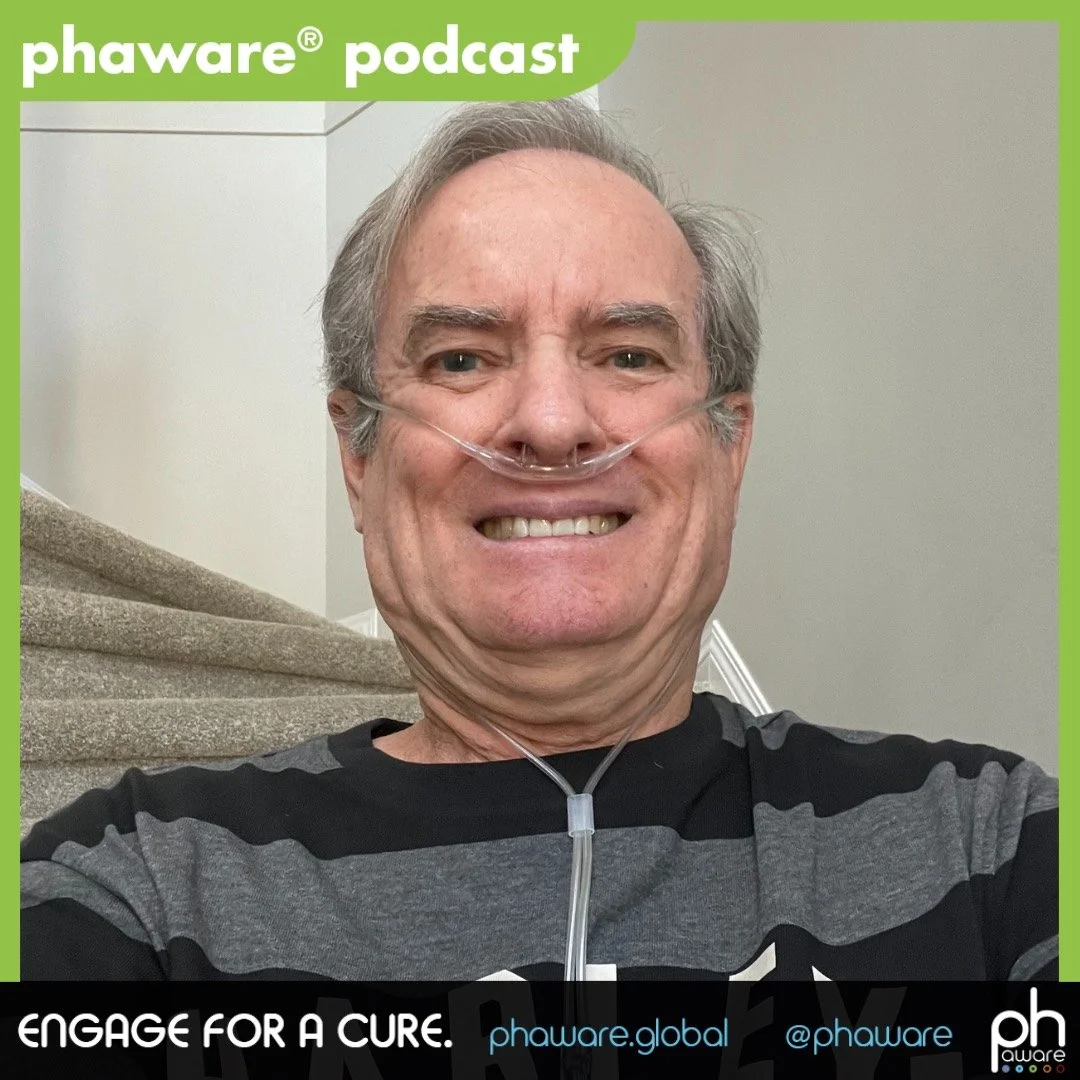
Me llamo Stephen Gariepy. Soy de Edmonton, Alberta, en Canadá. Me diagnosticaron HPTEC por primera vez en 2018. Lo que había pasado era que acababa de jubilarme y estaba empezando a disfrutar de la vida como jubilado. Me había apuntado a una liga de hockey para mayores y estaba muy metido en ello, jugando al hockey tres veces por semana. Por supuesto, todo se vino abajo con este diagnóstico.
Cada septiembre salía a patinar de forma recreativa y a prepararme para el inicio de la temporada, en octubre. Había empezado mi programa de patinaje. Había un gran reloj en uno de los extremos de la pista, y siempre lo utilizaba para comprobar cómo iban mis tiempos. Noté que había una pequeña mejora. Pensé: «Vaya, debo de haber perdido mucho la forma este verano». Así que seguí patinando, pero no avanzaba nada, así que pensé: «Bueno, haré como los demás y me pondré en forma jugando». Afortunadamente, pude disputar un par de partidos, pero me costaba mucho respirar. No sabía qué me pasaba. Luego, sufrí una lesión en el hombro que me apartó del hockey y así pude concentrarme en por qué no respiraba bien. Esto fue empeorando progresivamente hasta el punto de que… Vivo en una casa de dos plantas y apenas podía subir las escaleras. Era simplemente ridículo. No sabía qué estaba pasando.
Afortunadamente, mi médico de cabecera me lleva tratando desde hace 30 años, así que la confianza mutua entre él y yo fue una gran suerte, porque fui a verle y le expliqué lo que estaba pasando. Él pudo ver claramente que ni siquiera podía respirar. Así que programamos una serie de pruebas. A partir de la radiografía de tórax inicial, se dio cuenta de que parecía que podía tener hipertensión pulmonar. Lo que hizo entonces fue completar el resto de pruebas y enviar la derivación a la Clínica de Hipertensión Pulmonar de Edmonton. Pude acudir allí en el plazo habitual de cuatro a seis semanas. Conseguí mi cita allí. Me reuní con el especialista. Me hicieron una tomografía computarizada y un electrocardiograma durante la cita. Me perdí por algún lado en Urgencias, porque no encontraban sitio para atenderme. Tuve que pasar por el sistema de urgencias.
Durante mi cita, por fin, sobre las 9:00, pude someterme a las pruebas. Afortunadamente para mí, eso demostró la dedicación del personal de la Clínica de Hipertensión Pulmonar. Era viernes por la noche y el médico esperó hasta que llegaron los resultados. Iba a ir a Disney World a la mañana siguiente. No sé cómo lo hizo, pero se quedó. Luego, vino a buscarnos a mi mujer y a mí a Urgencias y nos llevó de vuelta a su consulta, a la clínica. Echó un vistazo rápido a la tomografía computarizada y me dijo que sí, que padecía hipertensión pulmonar tromboembólica crónica.
At that point, he told me the only option was if I had an operation, which would have to be done in Toronto, because they had lost their search and had Edmonton. They went at it right away. There was another test that was required for the surgeons in Toronto, which was the heart catheterization and some other test. I’m not sure what they all were. I was getting tested so much I couldn’t keep track anymore. Then, they had to set up a video interview with the surgeon in Toronto. That was Marc de Perrot. Great man, very impressive person. He determined that I was a candidate for a pulmonary thromboendarterectomy.
They also noted that after the heart test and all that, they should probably do a bypass while I was opened up and that would allegedly make my heart stronger to survive the endarterectomy. So from October when I was diagnosed, I was able to get down to Toronto for the surgery. Of course, that came as quite an expense. The government did provide airfare and, of course, I had to travel with somebody, so I brought my wife. Then I had the surgery. It worked out to be, I think it was a little over 13 hours, because they had to do the bypass initially, and then they went in and did it. I was septic. I developed pneumonia twice.
The real kicker here was that I turned out to have allergic reaction to the Heparin and then I developed a blood clot in my leg. The Heparin reaction like that is unbelievably rare. The only way they confirm it is to send your DNA to a laboratory in Hamilton, where then, of course, it was confirmed. To make it a long story short, ultimately it ended up the thromboendarterectomy being futile because I instantly re-clotted because of the Heparin allergy. With all the complications and everything, I wound up in Toronto in the hospital there for 45 days. I came out no better than when it went in, actually. Possibly a little worse.
As I did not get better, I continued on with the Pulmonary Hypertension Clinic and they re-referred me back to Dr. Perrot in Toronto to look at other options. Ultimately, what was concluded was that I was too high of a risk to endure another pulmonary thromboendarterectomy, because of existing scar tissues and things of that nature just made the procedure too risky for me to have.
But they did conclude that they could refer me to a vascular surgeon who could look at doing what’s called a balloon pulmonary angioplasty. That was arranged for me to go back to Toronto. That doctor said until he got in there, he couldn’t tell. Whether or not he could proceed with it, because if it was 100% blocked, he had nothing to work with, he couldn’t get a catheter around it. But he said he wouldn’t know that until he went in. But he saw some kind of backflow with the blood and figured he could attempt it. So I was scheduled to have it done again the next day for both lungs. He was able to get through, inserted a balloon in one lung. That worked in opening up one of the arteries. Then, he went in to the other lung and successfully opened that one as well, which was great. Then, we flew home. I felt much better. I was still on oxygen, but that didn’t last very long.
At some point in the future, if I meet the requirements, I will be subjected to a lung transplant, but that’s down the road. I just take it every day by day, wake up in the morning and appreciate that I’m awake. On a humorous note here, what pulled me through the last time through the first endarterectomy was I said, “Please let me live so I can watch…” One of my daughters was just finishing off a degree, and I just wanted to be around for her to graduate. I take this as an omen. She was accepted for a post-graduate degree, but she started in September. So, I figured that’s got to give me two years because I have to see her graduate again!
My wife just recently retired in June, which is fantastic because being alone with this thing, you’re just sitting at home dwelling on your illness, so it’s great. I have my partner back. We’re guardedly proceeding with our retirement and seeing what limitations I have. There’s all the flying restrictions. I have to go through all that kind of crap, but that’s just part of the disease and learning to live with it.
I finally after years and years through the Pulmonary Hypertension Association of Canada, I was finally able to get hooked up with a PH buddy. I talked to him about twice, because he had had endarterectomy 10 years previous. After the 10 years he was deemed PH-free, so he kind of disappeared. I got to start working on that again.
When I was diagnosed with CTEPH, the first emotion is, “God hates me. What did I do?” You get a diagnosis like this. First thing you do, like everybody does, you look it up on the internet. It says one to three years, you’re dead. God. You go through the five stages, right? Anger, denial, until ultimately you’re at peace with it. I know what I’m up against. I’ve been through it all and living day by day. I wake up, I’m happy I woke up. I do everything I possibly can. Of course, there’s good days and bad days. There’s days I can barely get out of bed, and there’s days I feel okay. Of course, if I go to cut the lawn, I’ll throw the oxygen tank on and get out there. I can’t do anything physical just the way it is, at least without oxygen.
The surgery is a major surgery. It is huge. You’re made hypothermic. They stop your heart. They stop your brain. You’re clinically dead for 20 minutes for three periods, so you’re dead for an hour. The reality is that I’m living with a terminal disease. I realize that. I’ve gone through all the stages of grief and everything, and I just carry on. I know there is possibly a chance of getting a transplant down the road. By the time that happens, I wouldn’t even be eligible till I’m 70, and then the whole process will have to be reevaluated again. Until such time, I’m just going day by day, living with it, going through every emotion known to mankind. I got nothing left. I’m just living. It’s such a rare disease, you almost get tired of trying to explain it, so you say, “I’m sick.” There’s no denying it’s hard, what I’ve been through. I don’t think anybody’s been through, but I’m still here talking to you, so I’m winning. You just adapt and do what you can do.
My name is Stephen Gariepy, and I’m aware that I’m rare.
###
AYÚDANOS A HACER HISTORIA EN PH
Más información phaware.global
Escucha y suscríbete phaware.global/podcast
Apoya el movimiento phaware.global/donate
Comparte tu historia info@phaware.global
Descarga nuestra aplicación phaware.global/heartworksapp
Sigue a @phaware · #phaware